
Scaling Burger King’s Internal Admin Platform

Обзор проекта
BK Admin is an internal web-based platform used to manage Burger King restaurants and operations. It brings together administrative workflows for restaurant managers and office employees, including menu management, kiosks, orders, shifts, and reporting.
The company was moving away from a third-party solution toward an internally owned platform to gain greater control, flexibility, and scalability. Over time, BK Admin was becoming a unified foundation for administrative interfaces across the Burger King ecosystem.
Бизнес-контекст
The transition to an in-house platform created an opportunity to consolidate previously fragmented administrative tools and establish a consistent experience across different operational workflows.
At the same time, BK Admin was evolving iteratively: new functionality had to be delivered while the platform's design foundation was still being established.
This created several design challenges — from supporting complex data-heavy workflows to migrating existing interfaces and making the system scalable across both light and dark themes.
Ключевые метрики
Time on task
Error rate
Migration rate
Моя роль
I worked as a Product Designer across both new functionality and the evolution of the platform's design foundation.
My responsibilities included:
Designing new administrative workflows, including tables, lists, forms, and navigation;
Migrating existing interfaces into the BK Admin platform;
Improving and documenting the design system;
Introducing a variable-based color architecture to support light and dark themes;
Conducting field research with restaurant employees and managers;
Benchmarking and exploring interaction patterns;
Collaborating with Product Managers, analysts, engineers, and other designers.
The selected initiatives that best showcase my work on the product are described below.
Consolidating the Mobile App Admin into BK Admin
Проблема
Burger King's internal tools were gradually being consolidated into a single administrative platform. One of the critical migration projects was moving the mobile app's existing admin interface into BK Admin.
The legacy interface contained unnecessary functionality and used patterns that differed from the new platform, while the migration had a strict 1.5-month design timeline.
Задача
Redesign the existing mobile app admin experience within the BK Admin framework, simplifying the experience where possible while preserving the workflows users needed.

Подход
I worked closely with analysts, who acted as task owners, to understand requirements and clarify ambiguous scenarios.
My process included:
Analyzing the existing interface and identifying redundant functionality;
Conducting interviews with users;
Mapping user flows and validating them with analysts;
Benchmarking external products and existing BK Admin patterns;
Adapting the existing BK Admin components to the needs of the migrated workflows;
Designing the menu item list and item editing screens;
Iterating quickly with analysts throughout the process;
Documenting interaction details and edge cases for analysts and developers.
Because several designers were working on the migration in parallel, maintaining consistency with the emerging BK Admin language was particularly important.

Результат
Simplified the legacy admin experience by removing unnecessary functionality;
Established a consistent interaction language within BK Admin;
Enabled a smoother transition for existing users;
Reduced time on task;
Completed the design work within the 1.5-month deadline, allowing the migration to stay aligned with the broader mobile app redesign.
Building for a Scalable Light & Dark Theme
Проблема
As BK Admin evolved, the existing color styles were difficult to maintain and they did not provide a scalable foundation for supporting both light and dark themes.
The team needed a more systematic approach that could reduce inconsistencies and make future theme implementation easier for both designers and developers.
Задача
Create a scalable color architecture based on variables and introduce it into the team's design workflow.
Подход
I first audited the existing color styles and how they were used across the product.
I then researched approaches used by large digital products and mapped the existing production colors to their equivalents in the new system.
Based on this analysis, I developed a semantic token structure covering key categories such as content, background, and accent, with additional levels of transparency.
I implemented the variables in Figma and integrated them into the team's workflow.
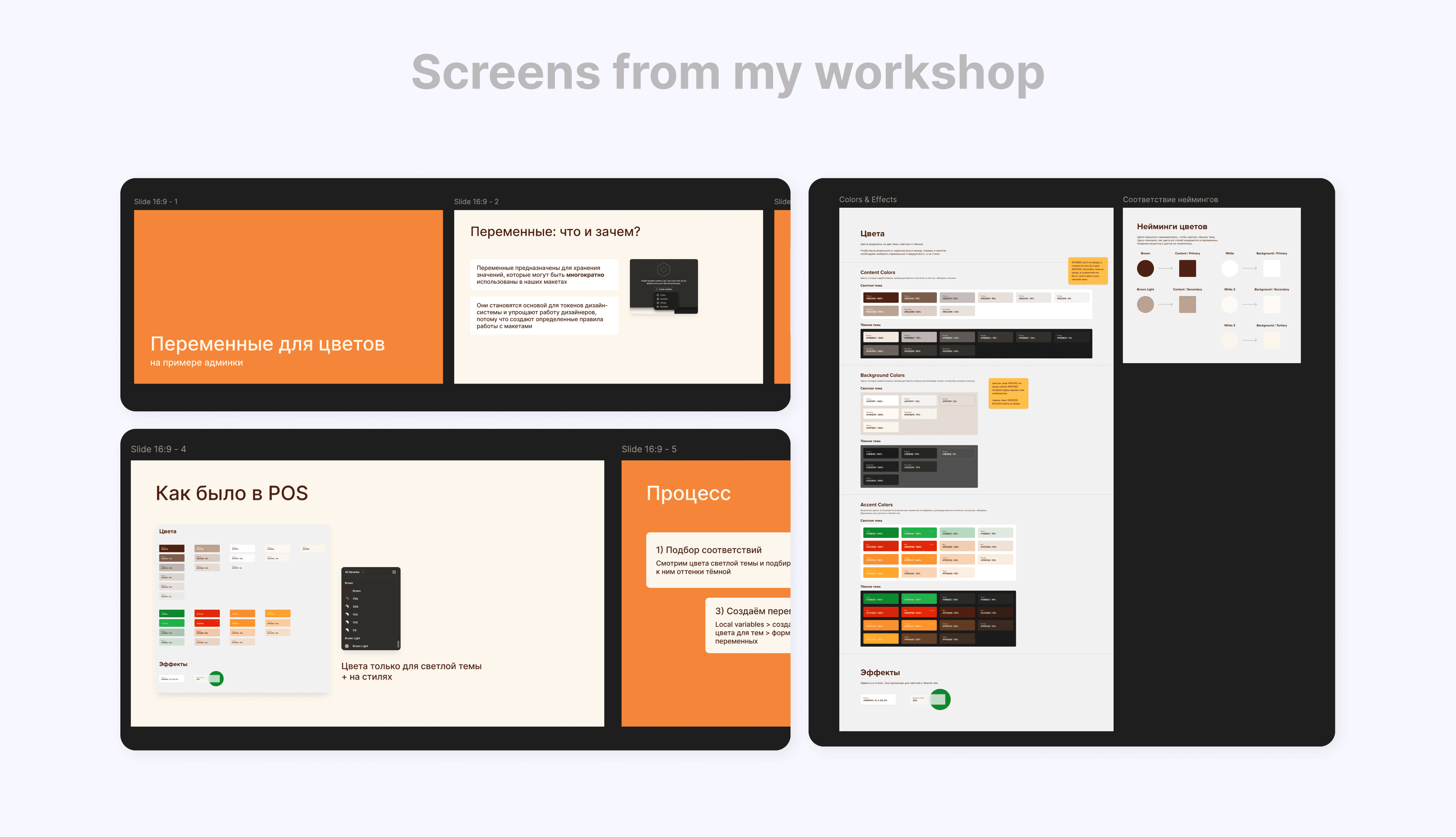
To make the transition practical for the rest of the team, I also ran a workshop for designers and prepared documentation for developers explaining the new color logic and the mapping between legacy styles and the new variables.
Результат
Established a unified, scalable color system for BK Admin;
Made dark theme implementation more predictable and consistent;
Reduced development errors during theme implementation;
Created shared documentation and conventions for the design team.
Designing from Real Restaurant Workflows
Проблема
Administrative workflows in BK Admin were closely connected to real-world restaurant operations, making it difficult to fully understand users' needs from desk research alone.
Задача
Understand how restaurant employees actually interact with internal tools and use these observations to inform product decisions.
Подход
I conducted several field visits to Burger King restaurants, where I:
Observed managers and restaurant employees using operational tools;
Conducted semi-structured interviews with managers;
Documented real-world scenarios and identified potential pain points;
Formulated hypotheses and discussed them with the product team;
Additionally observed how customers interacted with self-service kiosks to better understand the broader operational context.
Результат
The research helped the team validate and refine product hypotheses, identify operational pain points, and ground design decisions in real user behavior.
Общие результаты
Working on BK Admin allowed me to operate beyond individual feature design and contribute to the evolution of an internal product platform.
I helped make the platform more scalable and consistent by introducing a variable-based color system, supporting the migration of fragmented administrative tools, and contributing to a more unified interaction language.
At the same time, field research helped me connect interface decisions with the realities of restaurant operations rather than designing solely from requirements and existing interfaces.
This project strengthened my ability to design complex B2E workflows, work within technical and organizational constraints, and improve the systems that enable other teams to operate the product.
Some product details and screens are omitted due to NDA.
Читать следующий кейс